Make it easier
Reduce the decisions
Use four plain wing lobes, a simple body, and one large color patch on each wing pair.
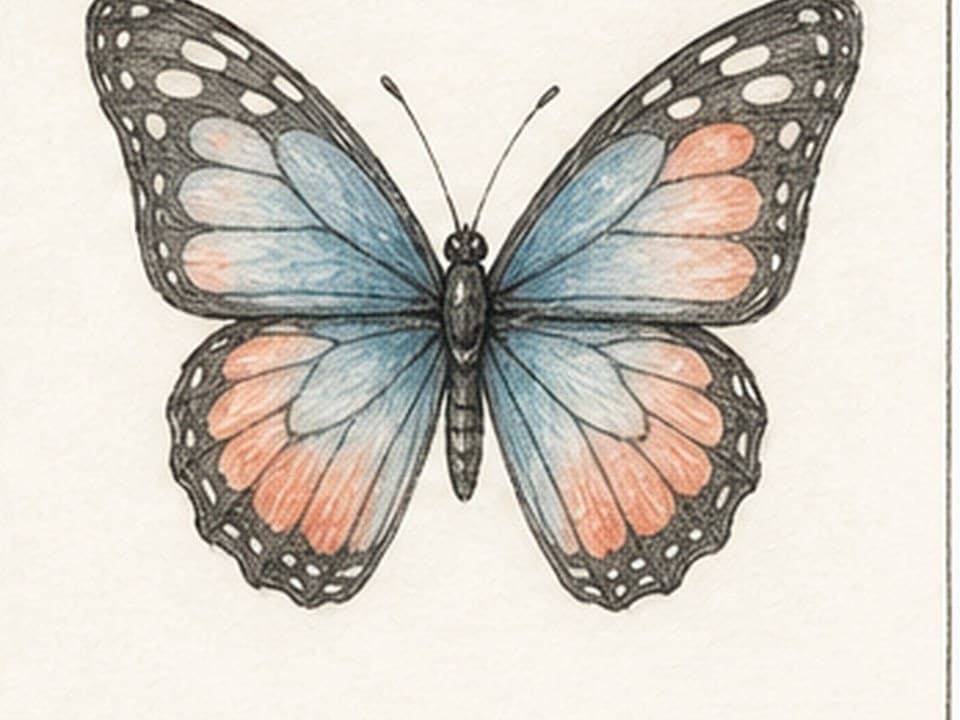
Illustrated reference · practice notes
Draw a butterfly with balanced wings and soft color blocks.
Practice focus
Compare rather than mechanically mirror the paired wing silhouettes, then organize repeated color patches inside their borders
Construction sequence
Draw the narrow segmented body vertically and mark the upper and lower wing attachment points on each side.
Shape the broad upper wings first, comparing their outer corners and scalloped edges across the body.
Add the smaller lower wings, keeping their lower tips and body overlaps balanced but not perfectly duplicated.
Establish the black border network before placing pale spots, blue fields, and coral patches within it.
Finish with tapered antennae and soften selected color edges while preserving the dark wing silhouette.
Make it easier
Use four plain wing lobes, a simple body, and one large color patch on each wing pair.
Make it harder
Map the scalloped border and spot groups with measured bilateral comparisons, then glaze transparent color without muddying the black pattern.
Difficulty rubric
The label is an editorial band, not a precise score. It considers the factors below; your feedback is stored locally and does not silently change the rating.
Project-generated local reference for the watercolor butterfly, derived from the row 3, column 3 crop of easy-cute-contact-sheet.png. The repository does not record the image tool or operator, creator attribution, or an external license, so this note claims no external redistribution rights.
Use the image here for observation practice. It is a single visual reference, not a demonstrated step-by-step tutorial.
Continue practising